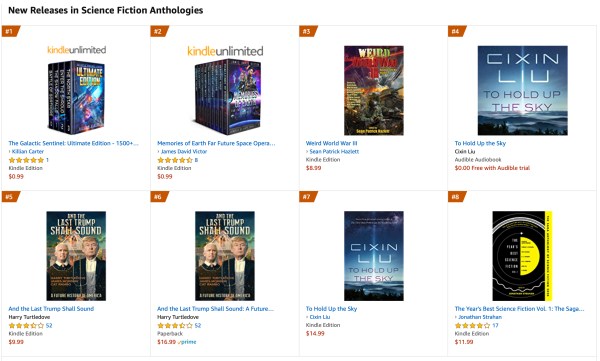
Within its first two days of launch, Weird World War III ranked as high as #3 on Amazon for new science fiction anthologies. For an unknown editor, I would qualify this as a success.
Having just gone through this process, I’ve put together some tips for new anthology editors. Some of these lessons may also benefit more experienced editors. As a caveat, these lessons are specific to my own experience. They may not apply to all cases. To the extent it was helpful, I used the data I gathered in the process of producing Weird World War III to come up with some rough rules of thumb.
I hope you find this summary helpful.
Lessons Learned
In putting together Weird World War III, I focused on four key areas, which I call the 4Ps: Pitch, Process, Production, and Promotion.
Pitch
The first step of creating an anthology is to develop the concept and then pitch that concept to potential publishers. When you create a pitch, you should consider the following elements below:
Develop a Compelling Theme: Theme encompasses both genre (literary fiction, science fiction, romance, horror, etc.) and what the anthology is about (space opera, weird western, vampires, mysteries, military science fiction, etc.). To land on a compelling theme likely to interest publishers, you should view your ideas through the below lenses:
Think Big: A publisher won’t buy your anthology if your theme isn’t commercially viable. To maximize your chances of success, you should pitch something that has wide appeal to the largest possible commercial audience. You want an idea that, when viewed in hindsight, is so universal, so obvious that other editors will kick themselves for not coming up with it before you did.
Be Strategic: Is the time right for your anthology? With tales of Russian intrigue in the US national zeitgeist, I knew if I pitched Weird World War III in 2017, it would likely come out shortly before the 2020 election. So I pitched something I believed would ride on the coattails of the US media’s obsession with Russian meddling in US politics. And sure enough, the anthology came out at the perfect time: one month before the US Presidential election.
Combine Two Familiar Concepts in a New and Interesting Way: You will want to include topics that are familiar and loved by your publisher’s audience, but different enough to be new and refreshing. The most straightforward way to accomplish this is by taking two familiar concepts and merging them together to create something new. Weird World War III merged alternative history with weird fiction. More specifically, it asked one overriding question: what if the US and Soviet Union had fought World War III? As I noted above, the idea seemed so simple and obvious, yet no one had done it yet.
Tailor Pitch to Brand: I pitched two projects to Baen. Baen declined my first pitch, but accepted my second. I’m convinced a major reason they turned down the first pitch, but accepted the second was because Weird World War III fit nicely within Baen’s wheelhouse of military science fiction and fantasy, while the initial pitch did not. In other words, knowing your market and tailoring your pitch to that market is critical in selling the project to a publisher.
Address Why You Are Ideal for the Project: You need to make a strong argument as to why you are uniquely suited to edit this particular anthology. Is the anthology about corporations in space? If it is, you’d better have serious corporate experience. Are you producing an anthology about space medicine? Well if you’re a doctor working at NASA, then you’ll certainly have a leg up. In my case, I argued I was uniquely suited for the Weird World War III anthology because I spent five years in the US Army fighting other units in training using Soviet armored doctrine and tactics. I also worked for Dr. Ashton Carter at the Stanford-Harvard Preventive Defense Project where I focused on nuclear proliferation. Lastly, I am a weird fiction, science fiction, fantasy, and horror writer myself, who’s published in various professional publications like Terraform, Vastarien, Galaxy’s Edge, Writers of the Future, Grimdark Magazine, and others.
Solicit Authors, Then Pitch Publishers: Before you pitch the publisher, line up the authors you’d like to appear in your anthology, then approach them to secure a loose commitment to write a story for it. Otherwise, if you are a new and untested editor, the publisher has no incentive to back you. After all, you are likely a relative unknown, and, aside from having a potentially good idea, you have a limited track record, if any. By recruiting headliners prior to the pitch, you minimize the publisher’s risk and thereby increase the chance a publisher will greenlight your project.
Learn from Other Editors: Sir Isaac Newton once said of his work, “If I have seen further it is by standing on the shoulders of Giants.” The same is true for Weird World War III. Before I sent anything to a publisher, I spoke to seasoned anthologists like Bryan Thomas Schmidt, Alex Shvartsman, Nick Mamatas, and David Boop. All were instrumental in helping me navigate the business side of the anthology, sharing their knowledge of pitches, contracts, editorial etiquette, and answering my random questions. New editors should learn as much as they can from the experts before they take on a task as daunting and complex as building a new anthology. I felt I was well suited to the task, given my knowledge, background, and experience, but editing is not for everyone. It’s better to know it in advance before one takes on such a commitment.
Prepare Multiple Pitches: The first time I solicited a short story from Mike Resnick and told him about the theme of the anthology, he asked what other ideas I had in the pipeline should the publisher reject my proposal. When I didn’t have an immediate answer, he gave me some great advice: always have 2-3 pitches ready in case the publisher rejects the first idea. When Baen turned down my first proposal, I had a pitch for Weird World War III ready to go. The rest is history.
Process
Cast a Wide Net: Before you pitch the anthology, you should generate a list of authors you’d like to invite 2-3x the number of authors you actually need. When you reach out to them, give them a brief description of the anthology and ask if they’d be willing to participate should a publisher buy the anthology. As you can see in the chart below, I sent out 49 invites, but only 21 authors ultimately had stories published in the anthology. In fact, 22% of writers failed to respond to the invite. Another 12% immediately declined and a further 4% answered with an ambiguous response (I’m a simple man, so I always assume ambiguous responses are polite no’s). Ultimately, 30 authors agreed to submit stories.
Recruit Headliners: Doing an open call may work for an established editor, but I wouldn’t advise it for a new one. There are so many unknown unknowns in the editing process that the additional workload of reading through thousands of submissions could be overwhelming. Instead, a new editor should focus on putting together the best possible anthology using more established authors with a ready fan base to maximize the probability of success.
Secure ~50% More Authors Than Needed: In the Weird World War III anthology, 21 authors initially agreed to provide stories, but only 14 of them ultimately delivered one. Consequently, I invited 9 more, 7 of whom had a story appear in the final anthology. In other words, to secure enough stories to finish the anthology on time, I had to ask 43% more writers to submit a story than ultimately delivered a submission. Just to be safe, I’d encourage new editors to secure 50% more writers than needed. In doing so, they should be very clear to submitters that there is a small chance their stories could be rejected. Below are several reasons why those stories never materialized:
Declines: Three authors subsequently declined because of legitimate reasons such as a change in theme (Two authors had signed up for a different theme) or timing (One author didn’t feel he could produce a good story in the time allotted and given his other commitments).
Flakes: Three authors completely flaked: they agreed to do a story, but never bothered to respond to my subsequent inquiries. I regard this behavior as a breach of professionalism and will never do business with these authors again. Most writers struggle to sell their stories. When an editor approaches an author with an opportunity to earn a professional rate for an unwritten story, it is a privilege. When a writer accepts such an offer, but for some reason, cannot deliver a story, they damn well owe the editor an explanation.
Emergencies: One author had a death in the family, so he was unable to produce a story in time. These things happen, they are completely understandable, and there’s nothing much you can do as an editor to avoid them. All you can do is offer your condolences and invite the author to the next anthology.
Timing and Suitability: I couldn’t publish two of the manuscripts, which were fantastic stories, but one did not fit the theme and the other came in after the anthology was filled.
Keep a Solid Stable of Relief Writers: As I noted above, in the last two months of the project, I reached out to another 9 authors because I was concerned I wouldn’t have enough stories to meet the publisher’s deadline. In the end, a total of 30 authors agreed to submit a story, but only 21 got published. When you create an anthology, make sure you have relationships with a stable of great authors who can produce professional quality prose in a pinch. Reach out to other editors to find out who these people are so you can reach out to them in an emergency (and if they aren’t already involved in the anthology).
Provide Clear and Concise Guidelines: You should provide authors with key details and deadlines at the front end of the process to avoid issues that can pile up at the back end. These include:
Theme: What’s the anthology’s theme?
Genre: What genre does the anthology cover? Crime fiction? Fantasy? Horror? Science fiction?
Word Count: What’s the word count for story submissions? What’s the range?
Pay Rate: How are you paying the author? A flat rate? Royalties? Per word? How much are you paying the author per word?
Key Deadlines: When is the logline due? What is the submission deadline? At what point will editing occur? When will authors receive their contracts? When will the anthology be published?
Expectations: Are submitted stories guaranteed to be in the anthology or is there a chance the editor will reject them?
Original Stories vs. Reprints: Will the anthology include only original stories, reprints, or a mixture of both?
Get Loglines Up Front and Early: To prevent multiple authors from submitting similar stories, you should request a one-sentence longline at the beginning of the process that describes what the story is about. Otherwise, you could end up in a situation the month before the manuscript is due with 7 stories on werewolves in a 20-story anthology about something other than werewolves.
Set Buffered Deadlines: Over 40% of the writers for Weird World War III missed their initial delivery deadlines. Some of them missed multiple subsequent deadlines. Rather than decry writers for behaving like writers, embrace this behavior. Plan for it.
Edit Submissions on Receipt: As noted above, nearly half of your authors will turn in there manuscripts late. To avoid a situation where you have to scramble at the last minute to piece together the anthology, read stories as soon as they come in and decide whether they are likely to make it into the anthology. If you decide they are, edit them immediately, then incorporate them into your working manuscript. You will thank yourself during crunch time.
Secure Contracts: As soon as you decide a writer’s story will be included in the final manuscript, send them a contract. If you wait until the end of the process, there’s a risk they reject your terms. If they do that, they could leave you in the lurch and scrambling for another author to write a new story at the last minute.
Pay Authors: The due date for paying your authors will be determined by the contracts they sign. Make sure your contract allows you to pay them after your publisher formally accepts the manuscript and pays you a portion of the advance. I’ve heard of situations in which an editor accepts a story and pays the author, but the publisher subsequently removes that story from the anthology. As a new editor, you never want to put yourself in this situation. So structure your contracts so you don’t pay the writers until the publisher accepts the manuscript. Additionally, paying authors out of your own pocket before the publisher pays you is akin to extending the publisher a zero-interest loan. For Weird World War III, I paid the authors after Baen accepted the manuscript but before I received the second half of my advance. At the end of the day, I didn’t want the authors who’d submitted their stories to have to wait too long to get paid.
Production
Start Strong: The first story in the anthology should hook readers, because that story is likely going to be the only one they read before deciding to buy the book. It is advisable to put one of the best stories up front, preferably by a headliner revered by the anthology’s target audience. For Weird World War III, I kicked the anthology off with David Drake’s “The Price”, an excellent story by a well-regarded headliner.
End Long: Similarly, you want to end the anthology with a bang. You also want to end long, so the last story lingers with readers long enough that they’ll recommend the story to other readers. Sometimes it’s also a good idea to end with a headliner, but a headliner with whom the anthology’s core audience is less familiar. In other words, it’s an opportunity for the editor to introduce a headliner from an adjacent genre. For Weird World War III, I closed the anthology with John Langan’s “Second Front”, an extraordinarily good and creepy story. While John is well-known among horror aficionados, he is less familiar to Baen’s core audience.
Alternate Headliners and Up-And-Comers: As an editor, I also try to alternate stories from headliners with up-and-comers. Doing so gives talented new writers a chance to introduce themselves to a larger audience.
Be Deliberate about Story Order: There are n! ways to order the stories in your anthology, where n is the total number of stories. However, you should make an effort to have an overarching organizing principle in your volume, otherwise, you aren’t really doing much of a job as an editor. Here are some examples of how you might order your stories. None of these are mutual exclusive or collectively exhaustive.
Tone: It helps to be mindful about the tone of your stories. For instance, your anthology might come off as unbalanced if you put all your funny stories in the beginning and lumped all your dark stories in the middle. Give your readers a breather after an emotionally draining story by following it up with a light-hearted comedy.
Length: It’s also a good idea to alternate stories based on length. You don’t want to wear readers down with a string of novelettes and then end with three flash fiction stories. It’s better to start with a medium-length work followed by a short piece, then a longer piece. Then repeat the sequence.
Style: Varying story styles also helps. Sometimes it makes sense to follow a complexly-woven story with ornate language with a straightforward and simple narrative. Furthermore, putting more experimental stories toward the back of the anthology reduces the risk that less adventurous readers will stop reading. By putting more challenging tales in the back half of the volume, readers are more likely to try them after having already read that far.
Theme: Sometimes you can organize your anthology around particular attributes related to the theme. For instance, in Weird World War III, I tried to alternate stories with a Soviet protagonist with stories with an American protagonist. I did the same for stories about different military branches. For instance, I tried not to have two back-to-back stories about the navy, army, or air force.
Promotion
Send ARCs and eARCs to Key Influencers: As soon as you submit the anthology to the publisher, you should compile a list of key influencers along with their emails and addresses so the publisher can send them an advanced reading copy of the book or ebook for review. Aside from having my Big Idea piece published on John Scalzi’s site, Whatever, and getting a positive review at This Is Horror, I failed miserably at this task for Weird World War III. To date, I haven’t seen anyone do a formal review of the anthology at any of the sites I asked my publisher to send ARCs or eARCs. I still need to assess exactly where I fell short, but this is clearly an area of weakness for me.
Reach Out to Influencersand Book Reviewers at Major Media Outlets: While producing a great anthology is critical for success, it doesn’t really matter if no one discovers your book. The more people who see it, the more copies you will sell. And the most efficient and effective way to maximize the number of people who are exposed to the anthology is to contact influencers and book reviewers with the biggest platforms. And by biggest platforms, I mean largest audiences.
All Things Considered:For example, booking a segment on NPR’s All Things Considered would reach an audience of 14.7 million. If just 0.1% of listeners purchased your book, you’d sell 14,700 copies.
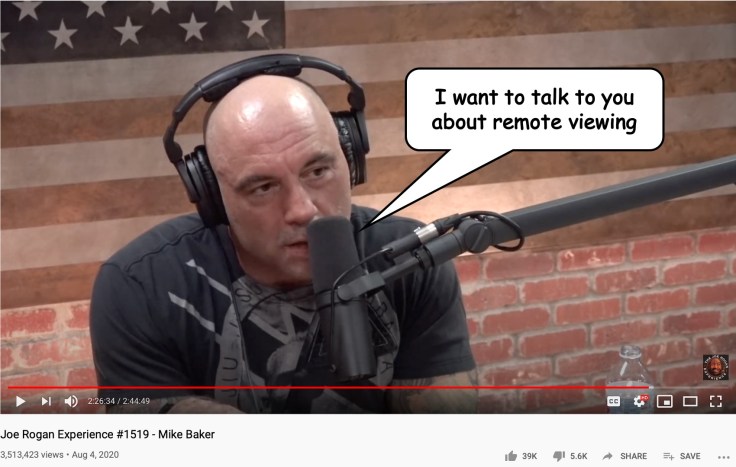
The Joe Rogan Experience:The Joe Rogan Experience has an audience of 9.73 million subscribers (as of October 11, 2020). And when it comes to booking appearances on these shows, you should be absolutely shameless. Use your network to get a leg up. As an example, my old CFO used to be the COO of Bellator, a competitor of the Ultimate Fighting Championship (UFC), where Joe Rogan was a commentator. So I asked my old CFO if he knew Joe or people who did. It turns out he did, so I asked him to forward my proposal to Joe Rogan for T.C. McCarthy and I to appear on his podcast. For me, appearing on The Joe Rogan Experience was an extreme long shot. To this day, it still hasn’t happened. That said, I have no doubt Joe Rogan or someone on his staff read my proposal, because two days after I sent it, Rogan asked guest, Mike Baker, a question about an obscure concept called remote viewing–a concept T.C. and I included in our proposal.
Reaching Other Major Media Outlets and Influencers: I also worked with a friend from the communications department at work. Using his network, he provided me with a curated list of all the major book reviewers at the Wall Street Journal, New York Times, Washington Post, and others. So I took that list and sent out 132 emails pitching Weird World War III.
Work Your Network: Many people are very good at some things, but terrible at others. You are no exception. Before you launch your anthology, take stock of your network. Who’s got great business experience? Who’s worked extensively in public relations? Does anyone you know have experience editing anthologies? Find out who these people are and ask for their help. At the same time, be willing to help them as well by offering your own expertise.
Always Be Closing: In the movie, Glengarry Glen Ross, Alec Baldwin’s character berates an underperforming sales team. In that scene, he explains what it means to always be closing. The surest way to edit another anthology is to generate strong sales on your first. Fortunately, you have some influence on this.
Direct Sales: Any time you are chatting with friends or coworkers, casually mention you have a book coming out. If you feel comfortable, ask them to buy a copy. If you are shameless, ask them to buy one on the spot via Amazon. Tell them you’ll sign it when it arrives. To date, Greg Schauer and I have shamelessly hand sold 121 copies of Weird World War III–and yes, I am counting every single sale.
Indirect Sales: As you leverage blog posts and social media to reach your audience, make it as easy as possible for them to buy your anthology. A link to Amazon or other online bookstore should always be no more than one click away.
Promote Writers: While anthologies typically do not sell as well as standalone novels, they do have one major benefit: they leverage the networks of multiple authors. To take advantage of this fact, I published 1-2 pieces on each Weird World War III author every day over a period of 19 days (you can find all these pieces consolidated here). Not only did this keep Weird World War III in the limelight, but also it exposed fans of each individual author to Weird World War III. Additionally, I published a piece that pointed Weird World War III fans to books these authors currently had in the marketplace or were about to launch. Because if your authors do well, you’ll do well.
Have a Dedicated Website: Having a public landing page where potential readers can learn more about you and the project is critical. Not only can they find everything in one place, but also you’ll have a central repository of information you can use and reuse to promote the book. The alternative is Facebook, which can and will take down a post at any given time for no particular reason. Having a Facebook Page for your project is a fine idea, but you should have a standalone presence on WordPress or other blog site to maximize control over your project’s public content. I mean, have you ever tried searching for a picture you posted on Facebook 10 years ago? Good luck with that.
Leverage Social Media: Unless you’ve been living under a rock for the last 14 years, you understand the need to make use of social media like Facebook, Twitter, and Instagram to get your book noticed. For Weird World War III, I’ve found Facebook to be far more effective than Twitter and Instagram in driving traffic to my website. During launch week, you’ll want to ensure you publish a steady drumbeat of posts, but no more than one or two a day. Otherwise, people will tune you out.
Solicit Amazon Reviews: Amazon’s ranking algorithm incorporates your book’s reviews. The more reviews your book has, the more copies it’ll sell. So it is incumbent on a new editor to solicit as many reviews as he or she can from their network. Sending out ARCs and eARCs to reviewers well in advance of the release so they have reviews ready to go on launch day is extremely important. This is one area where I came up short as I didn’t have a single Amazon review by launch day. That said, not all is lost. I’ll continue to encourage folks to provide reviews over the next several weeks to keep the momentum on Weird World War III going.
Schedule Events: I had originally planned to hold 23 signing events among all 22 people involved in the anthology (i.e., 21 authors + 1 editor). Then the coronavirus pandemic struck, and most bookstores cancelled all their live events. I ended up doing two masked and socially distant events outside with the help of an independent bookstore, Between Books, in my hometown and my cousin’s bar, The Be Here Brewing Company, in Pennsylvania. The two events were big successes. We ultimately sold 40+ copies of Weird World War III within one week of launch.
Adapt and Overcome: As I mentioned above, the coronavirus disrupted my book’s launch. I had to adapt and overcome the obstacle the pandemic presented. So I called the bookstores on my event list and volunteered to have authors come in and sign the store’s stock of Weird World War III whenever those authors were available. In many cases, such a call would prompt stores to order 2-4x their initial orders. Baen also invited me to participate in virtual events at Dragon Con as well as recorded a forthcoming podcast with me and several Weird World War III authors. I also continue to do any and all podcasts and radio shows that’ll have me. After all, selling the book doesn’t end on launch day.
If you’ve found this blog post useful, please share liberally. Also, please pick up a copy of Weird World War III to see how it all came together.
In the picture above, I’m standing in front of my childhood home in Wilmington, Delaware on the Weird World War III launch date, October 6, 2020. It feels nostalgic to be at the place it all started. Weird World War IIIis my first traditionally published book as an editor or author. I’ve had short stories that have appeared in others, but this book is the first traditionally published project for which I was directly responsible and accountable. Without me, it would never have existed, but without others, it would have have gotten off the ground.
Author Tim Waggoner writes a blog post every time he has a new book coming out. I’d like to do the same, and what better time to start than now.
Standing on the Shoulders of Giants
“Never forget where you came from.”
— Fred Collier
In my early twenties, a junior officer named Fred Collier gave me some of the best guidance in life. Right before he left the Army, he told a group of officers to “never forget where [they] came from.” For me, it was not only a call to be humble, but also it reminded me that nothing I ever accomplished was truly done on my own.
The experience of producing this anthology was no different. I am thankful that Toni Weisskopf at Baen took a risk on me as a first-time editor. Without Mike Resnick‘s guidance and support, this anthology would never have been possible.
Without Nick Mamatas, I would never have been introduced to writers and friends like T.C. McCarthy and Erica Satifka. Nick was also instrumental in graciously answering all my random editorial questions. And to top it all off, he wrote an amazing story for the anthology.
I am also thrilled to have had the opportunity to work with writers I am in awe of like David Drake, John Langan, and Mike Resnick. None of them needed to participate in this anthology, but I’m damned pleased they did.
Throughout the journey of producing this anthology, I also got to collaborate with folks I’ve known for over thirty years like Greg Schauer, who runs Between Books in Wilmington, Delaware. Greg worked with Baen to set up one of only two of my signing events in this post-COVID world. It seems like only yesterday when I discovered his store as a twelve-year-old kid playing Dungeons and Dragons.
I would be remiss to not thank Corinda Carfora at Baen for helping me with all the marketing and coordination for birthing my book into the world. I’d also like to thank John Goodwin and the folks at Author Services for helping me set up interviews to promote the anthology. I want to thank Michael Wilson and Bob Pastorella at This Is Horror and John Scalzi for using their platforms to help me promote my work (Weird World War III is tentatively scheduled to appear on The Big Idea tomorrow). I am also grateful to have worked with Tony Daniel through a seamless and organized editing process. I also couldn’t be happier with the cover Kurt Miller delivered for the anthology. It truly captured the essence of Weird World War III.
The Road to Success Runs Through Failure’s Gauntlet
“Life ain’t fair.”
— Theodore J. Hazlett, Jr.
It couldn’t have been a crazier year to launch this anthology, but it’s certainly been a weird one. Each month could’ve been a standalone geopolitical thriller: a once-in-a-century pandemic that swept through the United States, killing over two hundred thousand souls to date; one of the most contentious election cycles in US history muddied by conspiracy theories and Russian intrigue; the adverse economic impact of COVID-related business shutdowns driving the highest US unemployment rate in decades; civil unrest in major US cities resulting in the most costly riot damage in US history; Western wildfires causing billions of dollars and destroying millions of acres that turned the sky blood-red; increasing tensions between the world’s two most populous nations over the contentious Line of Actual Control in the Himalayan foothills; and now a proxy war between Armenia and Azerbaijan with Russia and Turkey lurking in the shadows.
My father gave me the best advice you could give a child to prepare for a world filled with such adversity and capriciousness: “life ain’t fair.” It was great advice because it’s not only true, but also it helps one steel oneself against the vagaries of life; to never count on good fortune. It taught me to make my own luck; to hope for the best, but prepare for the worst.
It was a long road to get to this point in my writing career. I’ve been writing and submitting stories since 2011, and it oftentimes feels like an endless stream of disappointment and rejection. In fact, unless you are one of the incredibly talented and lucky few, as a writer and/or editor, you should expect an astonishingly daunting number of rejections before you succeed. In my opinion, the only thing that separates a published author from an unpublished one is a published author never quits. Writers speak of this rejection so often it might be easily discounted as hyperbole. It’s not. My personal experience is empirical proof of it.
Since 2011, I’ve:
Written 65 original short stories
Written 2 novels
Entered the Writers of the Future Contest 17 times
Submitted those 65 short stories 2,381 times
Received 2,151 short story rejections
Haven’t sold a single novel yet
And yet I persisted. I didn’t quit. If I had thrown in the towel, I would have missed out on the joy of selling stories I created from nothing.
Since I finished and submitted my first short story on December 17, 2011, I’ve:
Sold 44 original short stories (68% of short stories written)
Sold 9 reprints, including 4 stories to various “Best of” anthologies
Been a winner in the Writers of the Future Contest
There’s still a long road ahead, but when I look back on the last 9 years, I’ve definitely made a ton of progress. And for that, I am thankful.
Support the Authors
Working with authors I admire was one of the most rewarding experiences of putting together this anthology. Reading the stories they created really brought my vision for Weird World War III to life. If, after reading their stories, you’d like to see more from them, I’ve included a list of some of their current or upcoming publications you should definitely check out.
As for me, all I ask is that you: 1) buy a copy of Weird World War III using any of the links below and 2) post a review on Amazon (the more reviews Weird World War III receives, the higher Amazon’s algorithm ranks it). Thank you. And I hope you enjoy the anthology.
Many authors in the science fiction, fantasy, and horror genres track their writing progress and provide a summary of it at the end of each year. For instance, David Tallerman, John Scalzi, Nick Mamatas, Joe Abercrombie, and Rahul Kanakia provide fairly comprehensive years in review that cover what they published in 2018/2019. In 2015, 2016, 2017, and 2018, I published posts tracking my progress up to those points in my writing career. Similarly, this post tracks the entirety of my writing career up to and including 2019.
Key 2019 Accomplishments
From a writing perspective, 2019 was an average year and the ninth year I’ve made a concerted effort to generate income from my writing. During 2019, I accomplished the following:
7 of my stories appearing in print, on the web, on ebook, or in audio for the first time, including:
Completing my first anthology with Baen Books called Weird World War III, which should be coming out next fall.
Moderating a panel on “Writing Beyond King and Colony” at Irish Worldcon with Joe Abercrombie, Brenda Clough, and Natasha Bardon.
2019 Accomplishments vs. Objectives
While I certainly made some progress in 2019, I came up short on many of my goals. In an effort to keep myself ruthlessly honest, I’ve coded goals I’ve accomplished in blue, goals I’ve failed to meet in 2019 because of factors beyond my control but are still on track in gray, and goals that I’ve failed to accomplish in red. I’ve also included some commentary to note how close (or how far) I was from realizing each of these goals.
Write 10 new short stories: I wrote 3 short stories–7 stories short of the mark.
Make at least 5 professional rate sales: I only made 1 professional sale.
Sell a story to one of the big three print publications: Analog, Asimov’s, and/or Fantasy and Science Fiction.Still no progress on this front, but I will keep up the good fight until I made a sale at one of these publications.
Appear in a “Best of” anthology: No dice this year.
Complete my horror novel: While I completed a second draft of an occult detective novel this year, I don’t think it is quite ready for prime time yet.
Sell my novel to a major publisher: I’ve made zero progress on this in 2019.
Do at least one panel and/or podcast: I moderated a panel on “Writing Beyond King and Colony” at Irish Worldcon with Joe Abercrombie, Brenda Clough, and Natasha Bardon.
Do an author signing at Between Books in my hometown: Given everything going on this year, I hadn’t had a chance to go back east this year with enough time to organize a signing. I hope that Baen’s release of the Weird World War III will provide me with that opportunity.
Publish my second short story collection: Of the twenty stories in the collection, I still have yet to sell the last story. I intend to publish this collection after I finish selling the final story.
As you can see, I’ve accomplished only 1 of my goals, am still on track to accomplish another one of them, and have failed to hit the remaining 7. Yikes! While I can do better, the very discipline of setting these goals kept me focused throughout the year. As such, I will be setting my goals for 2020 at the end of this post, but before I do that, I’d like to cover my annual writing statistics starting with my 2019 writing revenue.
I still continue to make an embarrassingly little amount of money from writing. In fact, my business school classmates will probably look at me crosswise when they see the numbers and wonder why I’m wasting my time.
But you have to start somewhere. And in writing, the barriers to entry are very low. Let’s face it: all you need is a keyboard, a rudimentary understanding of English, and an imagination, and you can submit to most magazines. To stand out among thousands of submissions you have to write something that blows away the competition. Over time, as one establishes oneself, it seems to get a little easier. It just takes a long time getting there.
All that being said, 2019 was actually the highest revenue year I’ve ever had. The majority of that revenue can be attributed to a portion of the advance from Baen for my upcoming anthology, Weird World War III. However, because of the rates I paid the authors, the anthology must do much better than earn out the advance before I see a dime of earnings.
While the revenue numbers above are still low, my revenue growth rate has roughly doubled each year from 2013 to 2015 and tripled in 2016—a marked improvement. Then revenue continued to decline–down 8% in 2017 and down 56% in 2018. In 2019, revenue shot up by 509%, primarily due to a partial advance on a short story anthology. Excluding this advance, my revenue would have been up 23% in 2019. And I’m already starting 2020 with a robust backlog that publishers still owe me for stories and anthology work equivalent to 81% of my 2019 sales.
I also find consolation in the fact that I’m literally making money by conjuring stuff out of thin air.
My revenue stream was a bit more diversified in 2019 than it was in 2018 with only 20% of my revenue deriving from short stories vs. 99% in 2017. As always, I’m hoping that a future novel sale will help diversify these revenue sources.
Other Writing Statistics
Since December 2011, I’ve written a total of 61 short stories. By the end of 2019, I sold 42 or 69% of them, and 39 have already been published. While a 69% hit rate seems pretty impressive on the surface, I’ve sent out 2,275 submissions to publishers and have accumulated 2,055 rejections to get there.
As I noted above, I sold 5 short stories this year, which is down 44% from my 2018 sales. However, to put that number into perspective, prior to 2016, I’d sold a total of 16 stories in my lifetime. From 2016 to 2019, I’d made another 41 sales, including 26 originals, 1 corporate sale, and 8 reprints. More importantly, 1 of those 2019 sales was at a professional rate. While that’s not very impressive, it’s important to note that I only wrote 3 new stories in 2019, 33% of which sold at a professional rate. Also, prior to 2016, I had only 1 professional sale; after 2015, I had 8.
You can’t win if you don’t play, and the more you play, the more you win. For a relatively unknown author, the writing game is one that rewards persistence. There’s also a huge element of luck. Sometimes you have to hit the right editor at the right time with the right story. You can’t do that if you aren’t constantly taking shots on goal. As such, from 2014 to 2016, I’d consistently submitted at least one story a day to various publications. Since my acceptance rate doubled from 2015 to 2016, I sent fewer submissions in 2017 and 2018, primarily so I could spend more time writing than submitting. I continued to follow this strategy in 2019, but I had far fewer submissions, mostly because I had written only 3 new short stories.
The writing business isn’t for the faint of heart, and rejection seems to be the only constant. The flip side of making a huge volume of submissions is that you receive a massive number of rejections. While I’ve sold over two-thirds of the stories I’ve written thus far, I’ve collected over 2,000 rejections. The good news is I’ve received so many of them I’ve built up enough scar tissue that they hardly bother me anymore. In fact, they only encourage me and spur me on.
Putting it all together, I’ve made decent progress since my first short story submission in December 2011. While I’m nowhere near quitting my day job, I’ve made enough progress that I can see light at the end of the tunnel. Below is how the numbers have shaken out thus far for me. As you can see, I’ve sent nearly 2,300 submissions to various publications to yield a total of 51 sales for 42 original short stories out of a 61-story inventory. But for most, writing isn’t a blitzkrieg, it’s a war of attrition. And it’s a war I’m determined to win.






 Through A Glass Darkly