Bryan Thomas Schmidt is a national bestselling author and Hugo-nominated editor whose works include the original novel series the John Simon thrillers and the space opera trilogy Saga of Davi Rhii as well as official entries in The X-Files, Predator, Joe Ledger, and Monster Hunter International. He’s edited thirteen anthologies and dozens of novels, including the international phenomenon The Martian by Andy Weir. He also authored the writing book How To Write A Novel: The Fundamentals of Fiction. He can be found on Facebook and Twitter as BryanThomasS or at his website: www.bryanthomasschmidt.net.
His and Peter J. Wack’s story, “It’s A MUD, MUD World”, appears in the Weird World War III anthology.
Tell me about yourself. Where are you from? What’s your background?
I am from Ottawa, KS at present but grew up about 3 hours west in Salina. I have a background in music and performance as well as consulting with various companies, Fortune 500 on down.
What kinds of stories do you write? Why?
I like to think I write good stories, but I guess what you’re looking for is adventure stories—stories with action and conflict driving them, with a decent pace to them. I also like to mix humor in to create characters with interesting quirks and personalities.
What’s the craziest thing you’ve ever done?
I was working as a temp once in Kansas City when I suddenly found myself trapped in my cube with two mountain lions staring at me from the doorway. I didn’t know anyone’s name I was working with so I had to call out for “help” generically. Finally, a woman I knew was a higher up showed up and said, “There you two naughty boys are. I wondered where you wandered off too.” She apologized, grabbed them by the leashes, and led them off. What the hell she was thinking bring them into an office is beyond me but there they were. Thank God my mom insisted I leave clean underwear in my glove compartment.
If you could live anywhere in the world, where would it be?
The Florida Keys.
What’s your favorite book? Why?
Either Robert Silverberg’s Lord Valentine’s Castle or James Clavell’s Shogun. Both have amazing world building and characters with an epic drama that unfolds over many months and years and asks profound questions about friendship, life, love, human nature, and so on. They are real lessons in how to write epic adventures with vivid dialogue and character building and world building and each one I have reread multiple times since discovering them with equal joy each time.
Story’s Soundtrack
Each of the stories in this volume evoked certain themes and emotions that can sometimes be approximated with music. The below video is the editor’s best interpretation of the feelings and themes that this author’s story evoked. Please note that this is only the editor’s interpretation. The author did not know this portion of the blog post existed until the editor published it.
Alex Shvartsman is a writer, translator, and anthologist from Brooklyn, NY. Over one hundred of his short stories have appeared in Nature, Analog, Strange Horizons, InterGalactic Medicine Show, and many other magazines and anthologies. He won the 2014 WSFA Small Press Award for Short Fiction and was a two-time finalist for the Canopus Award for Excellence in Interstellar Fiction (2015 and 2017). He is the editor of the Unidentified Funny Objects annual anthology series of humorous SF/F, and of Future Science Fiction Digest. His epic fantasy novel, Eridani’s Crown, was published in 2019. His website is www.alexshvartsman.com.
His story, “A Thing Worth a Damn”, appears in the Weird World War III anthology.
Tell me about yourself. Where are you from? What’s your background?
I’m a writer and translator from Brooklyn, NY. I was born in the country that no longer exists (USSR) and arrived via an airline that no longer exists (Pan Am.) So there’s truly no going back. So instead, I choose to write tall tales and also to translate from Russian fiction that I want to geek out about with my friends. I also edit anthologies and a magazine (Future Science Fiction Digest). Sometimes, I even find time to grab a quick nap.
What kinds of stories do you write? Why?
I tend to write a lot of humor, because the snarky, sarcastic voice is my default (Not that you could guess this from my Weird World War III story). However, I won’t be boxed in. I’ve written everything from space opera to political fantasy, the latter being the genre of my inaugural novel, Eridani’s Crown.
Which of your short stories is your favorite? Why?
Hands down, the favorite short story of mine is “Explaining Cthulhu to Grandma.” It also happens to be my most successful, having won an award and been reprinted a bunch of times, but I also love it because it’s exactly the sort of combination of humor, action, and creative problem-solving that I enjoy committing to the page. This story is free to read online at the Intergalactic Medicine Show archive.
What authors have had the greatest influence on your writing? Why?
Fredrick Brown, Harry Harrison, Bob Sheckley, and Robert Silverberg, to name a few. I devoured their short story collections in translation growing up, and much of their style/approach to writing short fiction has really stuck with me.
Besides yourself, which other contemporary authors would you recommend?
Ken Liu, K. A. Teryna, and Shaenon K. Garrity are among my favorite contemporary short fiction authors.
What’s the craziest thing that’s ever happened to you?
I once got turned away at the border crossing into Malaysia and kicked out back into Singapore. Buy me a coffee at a convention sometime and I will tell you the entire story.
Story’s Soundtrack
Each of the stories in this volume evoked certain themes and emotions that can sometimes be approximated with music. The below video is the editor’s best interpretation of the feelings and themes that this author’s story evoked. Please note that this is only the editor’s interpretation. The author did not know this portion of the blog post existed until the editor published it.
Ville Meriläinen is a Finnish university student, author of speculative fiction, and Death Metal musician. His short fiction has appeared in various venues online and in print, including Orson Scott Card’s InterGalactic Medicine Show, Pseudopod, and Cast of Wonders. His musical fantasy novel, Ghost Notes, is available from Digital Fiction Publishing.
His story, “The Scholomance”, appears in the Weird World War III anthology.
Tell me about yourself. Where are you from? What’s your background?
I’m from a small-ish forest town on the west coast of Finland, from where I moved to study across the country to a small-ish forest city near the Russian border. While writing this, I’m visiting my parents, and can see the sea from the guest room window. Wood and water are prominent elements in my work and it’s no marvel why.
What kinds of stories do you write? Why?
The latest bio line I’ve given editors is: “Ville Meriläinen writes stories like the Finnish winter: long, dark, and someone probably gets hurt.” You try living without the sun for half a year and see how cheerful it leaves you.
Which of your short stories is your favorite? Why?
It’s always the latest one. I’m severely self-critical and whatever is newest usually feels passably competent. God forbid someone tells me they’ve read one of my older pieces, because the reaction is invariably thinking “Oh no not that one” while trying to convincingly smile and nod like I appreciate it.
Besides yourself, which other contemporary authors would you recommend?
I don’t think I’ve ever recommended authors over books, but Victor LaValle’s The Changeling, Justin Robinson’s The Dollmaker, and G. Willow Wilson’s The Bird King have hit me pretty hard lately, so I suppose there’s a list. I don’t know anything about the authors or their other works, to be honest. When you grow up on Black Metal you learn to separate art and the artist pretty fast.
What’s the craziest thing you’ve ever done?
All I want in life is to write silly stories in my bedroom and never talk to people, and yet somehow I keep winding up on stages. Dive bar stages, lecture hall stages, and then there was that one time in a black tie Hollywood gala beside a mechanical dragon and a number of genre grandmasters.
Story’s Soundtrack
Each of the stories in this volume evoked certain themes and emotions that can sometimes be approximated with music. The below video is the editor’s best interpretation of the feelings and themes that this author’s story evoked. Please note that this is only the editor’s interpretation. The author did not know this portion of the blog post existed until the editor published it.
Deborah A. Wolf was born in a barn and raised on wildlife refuges, which explains rather a lot. She has worked as an underwater photographer, Arabic linguist, and grumbling wage slave, but never wanted to be anything other than an author. Deborah’s first trilogy, The Dragon’s Legacy, has been acclaimed as outstanding literary fantasy and shortlisted for such notable honors as the Gemmell Award. This debut was followed by Split Feather, a contemporary work of speculative fiction which explores the wildest side of Alaska. Deborah currently lives in northern Michigan. She has four kids (three of whom are grown and all of whom are exceptional), an assortment of dogs and horses, and two cats, one of whom she suspects is possessed by a demon. Deborah is represented by Mark Gottlieb of Trident Media Group.
Her story, “Oderzhimost'”, appears in the Weird World War III anthology.
What kinds of stories do you write? Why?
Speculative fiction with a grimdark bent. Because that’s how I’m bent, I guess.
Which of your short stories is your favorite? Why?
I don’t have a favorite kid, and I don’t have a favorite story.
Besides yourself, which other contemporary authors would you recommend?
Anna Smith Spark, Anna Stephens, Michael Fletcher, Dyrk Ashton, Rob Hayes, and definitely Scott Oden. None of whom are members of a secret cabal of authors, honest.
What’s the craziest thing that’s ever happened to you?
My dog and I found an Ice Age bison skull when I was a kid. That was pretty cool.
What’s the craziest thing you’ve ever done?
It involved Tannerite. Beyond that, I plead the Fifth. (Also, I regret NOTHING).
Tell me about a time you almost died.
When I was nineteen or so, four of us hopped on three snowmachines and made an unplanned trip from McGrath to Takotna. On the way back, one of our drivers was drunk and took off, the second snowmachine broke down, and the three of us were stuck with one machine for the long trip back. It was seventy-something degrees below zero. Then our last machine broke down…
With duct tape and luck, the three of us made it back to McGrath at about 4 in the morning. My knees were frozen solid and my feet were pretty well frostbitten, but we all survived.
Bush Alaska can be a tough place. I’m fifty one years old now, and the only one of that group who is still alive.
Tell us something about you that very few people know.
I have an intense dislike of being hugged. Gross. It’s almost as bad as cole slaw.
What is your favorite speculative fiction genre? Why?
Nothing transports me like epic fantasy. Well-written epic fantasy is one of the chief delights in life.
If you could live anywhere in the world, where would it be?
The north shore of Maui.
What was your favorite subject in school? Why?
Reading/English/Language Arts, always and forever. I dedicated my first book (THE DRAGON’S LEGACY) in part to my high school English teacher Deane O’Dell. As to why… reading has always been my drug of choice. Writing is just reading in my head.
What’s your favorite book? Why?
THE HOBBIT.
Because it’s the greatest book ever written, that’s why. Fight me.
If you could live in any time period, when would it be? Why?
I rather like the present time period, if we could just skip through from November 2016 till the day they lead a handcuffed Trump off to begin his prison sentence.
Story’s Soundtrack
Each of the stories in this volume evoked certain themes and emotions that can sometimes be approximated with music. The below video is the editor’s best interpretation of the feelings and themes that this author’s story evoked. Please note that this is only the editor’s interpretation. The author did not know this portion of the blog post existed until the editor published it.
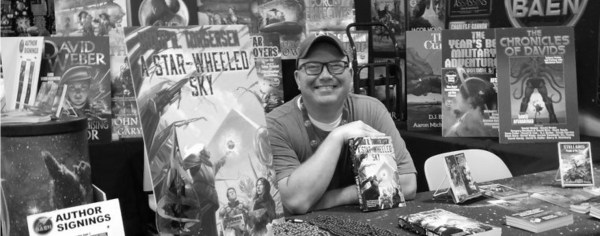
Brad R. Torgersenis a multi-award-winning science fiction and fantasy writer whose book A Star-Wheeled Sky won the 2019 Dragon Award for Best Science Fiction Novel at the 33rd annual DragonCon fan convention in Atlanta, Georgia. A prolific short fiction author, Torgersen has published stories in numerous anthologies and magazines, including several Best of Year editions. Brad is named in Analog magazine’s who’s who of top Analog authors, alongside venerable writers like Larry Niven, Lois McMaster Bujold, Orson Scott Card, and Robert A. Heinlein. Married for over twenty-five years, Brad is also a United States Army Reserve Chief Warrant Officer—with multiple deployments to his credit—and currently lives with his wife and daughter in the Mountain West, where they keep a small menagerie of dogs and cats.
His story, “All Quiet on the Phantom Front”, appears in the Weird World War III anthology.
What kinds of stories do you write? Why?
I tend to focus on stories which emphasize the everyman, who through determination and no small amount of courage and principle is able to forge a victory—despite the most overwhelming or dire predicaments. Too much fiction these days—be it books, stories, screenplays, you name it—seems to glory in the “complicated” character. Who is a morally ambiguous individual at best. I rather favor the idea that ordinary people are capable of extraordinary things (including extraordinary displays of honor, decency, integrity, and morality) when push comes to shove. I believe this is something we see in the world around us, and it will also be true in the future. Regardless of how advanced our technology may be, or when we eventually voyage to other planets and other stars.
Which of your short stories is your favorite? Why?
I’m going to echo the spoken word performance group Celestial Navigations and state that the best one, is the next one. I’ve enjoyed all of the stories I’ve published, and am especially proud of those which have won readers’ choice awards in magazines like Analog. But each new story is a new adventure in discovery. Because I am usually going to new places with new characters and exploring some facet of the human equation I’ve not necessarily explored before in that specific way, set against a canvas I’ve not necessarily explored before either. So, I take great joy in this activity, and am always pleased with how the characters and their stories evolve organically beneath my fingertips as I type.
What authors have had the greatest influence on your writing? Why?
Of all the living authors who are still with us, award-winner and science fiction Grand Master Larry Niven is the one who has had the greatest single influence. It was reading Larry’s short fiction (when I was still a teenager, thirty years ago) that inspired me to try to write my own professional stories. Up to that point I’d simply dabbled in fan fiction for franchises like Star Trek or Mad Max but it was while reading Larry’s short fiction that I said to myself, “I want to try to write this well, and publish myself!” It took me a lot of work and a lot of practice—including a lot of heartache and failure—before I finally broke in with my Writers of the Future winning story, ten years ago.
What is your favorite speculative fiction genre? Why?
I tend to favor the “hard” variety of science fiction, simply because I’ve always been fascinated by stories which try to imagine how humanity might actually voyage to the planets and the stars. Versus the numerous examples of Earth-bound dystopias which have been ironically popular in our era of fantastic opportunity, wealth, and material comfort. When I was child, movies and television series which depicted humanity journeying to other worlds, and conquering the literal final frontier of space, most captured my imagination. Which is not to say I don’t enjoy a very good fantasy story, such as Tolkien’s Lord of the Rings saga. Because I do. But my interest inevitably returns to stories that are well-grounded in known physics, chemistry, biology, etc., while projecting the human adventure into environments which—while potentially quite hostile—offer their own wonder and mystery, as well as challenges. To include potentially magical realms. I mentioned Larry Niven earlier. On those occasions when I approach a fantasy project of my own I tend to go at it “hard” in that the mystical or otherwise magical component is rigorously bounded, with rules and structure such that it’s an additional natural phenomenon, as much like gravity or electricity as anything else.
If you could live in any time period, when would it be? Why?
I don’t have a particularly favorite period, mostly because each period has its plusses and its minuses. I do consider myself to be a student of history, however, and am very concerned with how little many people in 21st century America seem to be paying attention to the lessons of history. Especially when it comes to utopian activism. Millions of Americans seem bound and determined to scuttle everything about our world which makes it clean, comfortable, and abundant, for the sake of some as-yet-to-be-realized fantastic vision of a “fair” society. Which—if people understood their history at all—is where all the greatest and most terrible human disasters of the 20th century began. We make a fatal flaw when we sacrifice what’s good on the altar of trying to achieve perfection. Otherwise? History is replete with amazing people and amazing events, some of the astoundingly inspired, others dreadfully awful. And all of it adds up to who we are now, in our time. Both good and bad things. Like I said, I wish more Americans especially in the 21st century paid attention to the lessons we should have learned from what happened in the 20th century especially.
Story’s Soundtrack
Each of the stories in this volume evoked certain themes and emotions that can sometimes be approximated with music. The below video is the editor’s best interpretation of the feelings and themes that this author’s story evoked. Please note that this is only the editor’s interpretation. The author did not know this portion of the blog post existed until the editor published it.




 Through A Glass Darkly